Almost there! Add $99.0 more for free shipping
Your bag (0)
Cart is empty
Cart is empty

Most commuter backpack guides are written by people who tested eight bags for two weeks. This one is written by people who’ve been designing the same commuter backpack since 2020 and have iterated it four times based on real-world feedback from the people who carry it every day.
That context matters. When you design a commuter backpack, you spend a lot of time thinking about airport security lanes. About what happens to a bag when it rains sideways in Sydney or San Francisco. About whether someone can reach a water bottle without taking the bag off. Small decisions. Daily friction points. The kind of thing a two-week test misses.
This is the honest guide to what actually matters in a commuter backpack — whether you’re buying the Sympl Commuter Pack or anything else.
Before you look at a single product, here’s what to evaluate. Not what the marketing says — what your commute actually needs.
Six things. If a bag fails two of them, move on.
The standard is a padded sleeve that suspends the laptop above the bag’s base — so if the bag gets dropped, the laptop doesn’t hit the ground. That’s the minimum. What separates good bags from average ones is how you access it.
A clamshell opening means the bag opens flat, like a suitcase. You slide your laptop in and out from a dedicated compartment that’s accessible without touching the rest of your gear. At airport security this matters more than you’d think — you’re not digging through your water bottle and gym shoes to find a 15-inch MacBook at 6am.
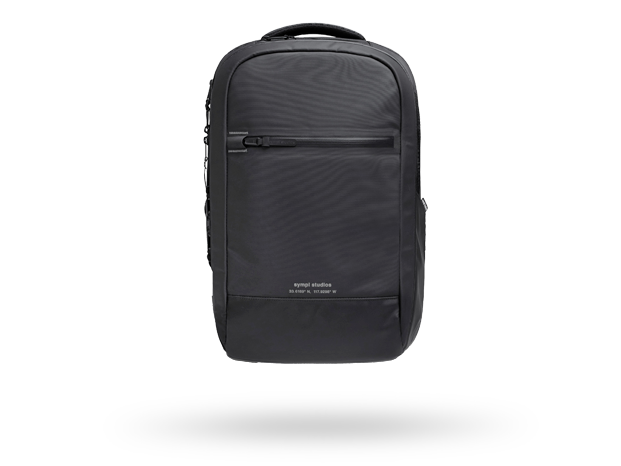
The Sympl Commuter Pack uses a clamshell design with a dedicated laptop sleeve suspended off the base. No hunting. No unpacking.
A bag with twelve pockets and no logic is worse than a bag with four pockets that make sense. The question isn’t “how many pockets” — it’s whether there’s a clear mental model for where things live.
The best commuter backpacks have three zones: a laptop zone (dedicated, quick-access), a tech caddy zone (cables, small accessories, anything electronic that isn’t the laptop), and a main compartment for everything else. That’s it. If you have to think about where something goes, the organization has already failed.
The strap system is where budget bags show their age fastest. Thin straps with no padding dig into shoulders after twenty minutes. Back panels with no structure press the bag’s contents directly into your spine.
Look for contoured shoulder straps — shaped to follow the natural angle of your shoulders, not just straight panels. A sternum strap matters for cyclists or anyone carrying more than 8kg. A trolley sleeve (a pass-through on the back panel) lets the bag sit flat on rolling luggage — underrated if you travel for work.

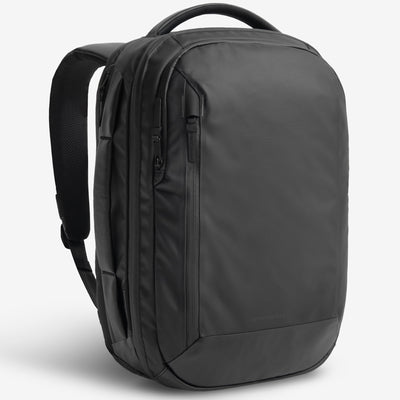
Featured Product
Commuter Pack
$239.00
Shop NowFor most commuters: 20–24L. A 20L commuter backpack fits a laptop, chargers, a water bottle, and a full day of gear without hitting capacity. Step up to 24L if you carry gym kit or work across multiple locations. Most commuters overpack by default — a smaller bag keeps you honest about what you actually need daily.
The honest answer: most commuters pack more than they need. A 20L bag forces discipline. A 30L bag becomes a moving closet.
A 20L commuter backpack fits a 15-inch laptop, a full day of accessories, a 1L water bottle, and a packable jacket without hitting capacity. That covers 90% of commutes. The advantage of 20L: it fits under an airplane seat comfortably, weighs less when empty, and keeps you from overpacking on reflex.
If you currently carry a 30L bag and it’s rarely more than half full, go smaller. You won’t miss the volume.
Go to 24L if your commute involves gym kit, a second pair of shoes, or if you frequently work from different locations and carry more than one device. The Sympl Commuter Pack is available in 24L for exactly this reason — same organizational architecture, more breathing room in the main compartment.
The X-Pac Commuter will be offered in both 20L and 24L when it launches.
The material spec on a backpack tells you more about its long-term durability than any marketing claim. Two bags can look identical and last completely different amounts of time — because one uses 420D recycled Cordura and one uses 210D uncoated polyester.
The “D” number (denier) tells you the thread thickness. Higher denier = denser weave = more abrasion resistance. 420D is the sweet spot for daily carry bags — tough enough for years of regular use, light enough to not add dead weight. Below 300D and you’re making compromises on durability. Above 600D and you’re usually paying for overkill on a commuter bag.
The other variable is coating. Raw nylon absorbs water. A DWR (Durable Water Repellent) coating sheds it. An X-Pac laminate takes it further.
X-Pac is a laminated composite fabric developed for high-performance sailing gear. It bonds a woven face fabric to a waterproof polyurethane film and a structural scrim — the result is a material that’s lighter than standard nylon, fully waterproof (not just water-resistant), and maintains its structure under load. It doesn’t get heavy when wet. It doesn’t sag. It’s what technical outdoor brands use when weight and weather protection both matter.
For commuters: this means your gear stays dry in a downpour, the bag holds its shape over years of use, and you’re carrying less dead weight. That last point matters more on a daily commute than it does on a weekend hike.
The standard Sympl Commuter Pack is built from 420D recycled Cordura — a certified recycled version of the same Cordura nylon used in military-spec gear. The recycled content doesn’t compromise performance. What it changes is the environmental footprint: the fabric is made from post-consumer PET (like plastic bottles), reducing the reliance on virgin petroleum in the manufacturing process.
Standard nylon at the same denier is cheaper to produce. It performs comparably in dry conditions. The difference shows up in the long run: recycled Cordura maintains color fastness and tensile strength longer than uncertified nylon alternatives, and it’s Bluesign-certified, which means the dyeing and finishing process meets strict chemical and environmental standards.
This is why we say 100% recycled materials rather than just “sustainable.” The spec is real.
We started designing the Commuter Pack because every commuter backpack on the market in 2020 made the same trade-off: either organizational depth or reasonable weight. Not both. The “premium” bags were overbuilt for office carry. The “minimalist” bags had nowhere to put a power bank.
The first version wasn’t perfect. The second was better. V2.2 — the version in production now — is the result of feedback from hundreds of commuters who carried earlier versions and told us exactly what didn’t work.


The strap system changed. Early users pointed out that the original shoulder strap placement sat too wide for narrower frames — the pack would torque to the side on a heavier load. V2.2 brought the attachment points closer together and added a removable sternum strap clip, which lets you dial in the fit for your build without being stuck with one configuration.
The water bottle pocket was redesigned. The original was elasticated and fine for rigid bottles, but struggled with collapsible soft flasks. V2.2 expanded the opening and added a secondary retention tab so the bottle actually stays put whether you’re on a bike or running for a train.
The laptop sleeve entry was extended. A small change — but getting a 15-inch laptop in and out one-handed was awkward in earlier versions. V2.2 made the opening wider and added a second grab point at the bottom of the sleeve.
None of these changes came from a design team working in isolation. They came from reading what our community was telling us, then actually doing something about it. That’s not a marketing story. It’s just how we build.
The standard Commuter Pack is the everyday carry option. 420D recycled Cordura, all the organizational features, available now in 20L and 24L.
The X-Pac Commuter Pack is the same design with an upgraded shell — X-Pac fabric on the body and main compartment panels, making it fully weatherproof rather than just water-resistant. It’s lighter than the standard version for the same volume, and it holds its structure longer. It’s coming in 24L and 20L, both in black.
Pre-order opens in approximately 30 days. If you’re cycling in any weather or regularly commuting in a city where rain is unpredictable, the X-Pac variant is the one to wait for. If you need something now and weather isn’t a daily concern, the standard Commuter Pack covers everything you need.
Explore the Sympl Commuter Pack →
The honest answer here: a good commuter backpack works for anyone who fits the carry volume. Most of what gets marketed as “women’s commuter bags” is just a smaller bag or a different colorway.
What actually matters for fit is torso length and shoulder width — not gender. If you have a narrower build, look for bags with adjustable strap placement (or at least contoured straps that sit closer to the neck) and a lighter empty weight. A 1.2kg empty bag becomes tiring fast on a smaller frame.
The Sympl Commuter Pack’s V2.2 strap adjustment addresses this directly. The sternum strap can be positioned across a wider range than most bags at this price point, and the strap width itself is designed to sit without digging into narrower shoulders.
The 20L version is the most popular among commuters who carry a laptop and a full day of gear without gym kit. If your daily carry includes gym clothes or a second pair of shoes, the 24L gives you the room without the bag feeling oversized.
Cycling adds requirements that most commuter backpack buyers don’t think about until they’re drenched.
Waterproofing. A DWR coating is fine for a light drizzle. Cycling in rain for 20 minutes is a different test — wind-driven water hits the bag from angles that standard coatings weren’t designed for. This is where X-Pac wins immediately: the laminate is rated waterproof, not water-resistant.
Stability. A bag that shifts while you’re riding affects your center of gravity, especially in traffic. A sternum strap is mandatory. The Commuter Pack’s sternum strap is removable when you don’t need it, but on a bike it keeps the bag locked against your back.
Back panel ventilation. A bag pressed flat against your back with no airflow makes sweating worse. Look for a raised channel in the back panel — it’s not a complete fix, but it makes a real difference over a 30-minute ride.

Getting the organization right matters as much as buying the right bag. Here’s the system:
For cyclists: run your lock cable through the top handle rather than inside the bag. Accessible without opening, and keeps the lock smell contained.
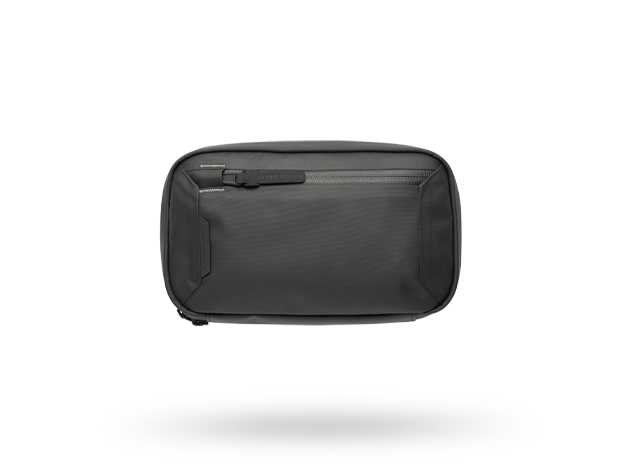
Building out your full kit? The Sympl Tech Kit fits inside the tech caddy layer and keeps cables from turning into a rat’s nest.
For most commuters, yes. A 20L commuter backpack holds a 15-inch laptop, daily accessories, a change of clothes, and a water bottle with room to spare. Go to 24L if your commute includes gym gear. If you’re carrying a 30L bag that’s rarely full, downsize — you’ll carry less dead weight every day.
X-Pac is a laminated composite fabric developed for sailing gear. It bonds a woven face fabric to a waterproof film and a structural scrim — making it lighter and more water-resistant than standard nylon while staying flexible under load. For commuters: dry gear in a downpour, less dead weight, a bag that holds its shape for years.
It fits within personal item dimensions for most major airlines and slides under the seat without issue. Check your specific airline’s limits — these vary, particularly on budget carriers. The 24L version may need overhead bin space on smaller regional aircraft.
Yes. The standard Commuter Pack uses 420D recycled Cordura — Bluesign-certified, made from post-consumer PET. Same performance spec as virgin Cordura, significantly lower environmental footprint. Full breakdown on our sustainability page.
Ready to carry better? Start with the Sympl Commuter Pack — or explore the full Performance Carry System.